
SULFUR: HISTORICAL HIGH IN H1, LINGERING GEOPOLITICAL TENSION IMPACT
General Market Performance
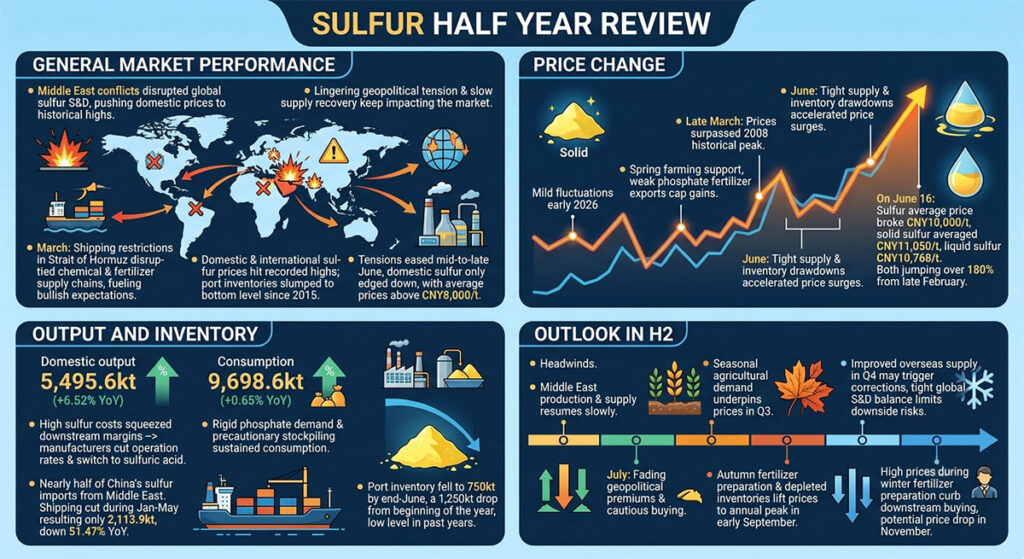
In H1 2026, Middle East conflicts disrupted global sulfur supply and demand, pushing domestic sulfur prices to historical highs. Lingering geopolitical tension and slow supply recovery will keep impacting the market. Since March, shipping restrictions in the Strait of Hormuz disrupted chemical and fertilizer supply chains, fueling bullish expectations to the market. Domestic and international sulfur prices hit recorded highs, while port inventories slumped to the bottom level since 2015. Tensions eased in mid-to-late June, yet domestic sulfur only edged down, with domestic average prices staying above CNY8,000/t.
Price Change
Sulfur prices fluctuated mildly at the beginning of 2026. Spring farming demand offered mild support, but weak phosphate fertilizer exports capped gains. By late March, domestic sulfur prices surpassed the 2008 historical peak. Tight supply and continuous inventory drawdowns accelerated price surges in June. On June 16, sulfur average price broke CNY10,000/t, with solid sulfur averaged CNY11,050/t and liquid sulfur CNY10,768/t, both jumping over 180% from late February.
Output and Inventory
Domestic sulfur supply and demand saw modest growth in H1, 2026. The output reached 5,495.6kt, up 6.52% YoY. Consumption hit 9,698.6kt, a slight 0.65% YoY rise. High sulfur costs squeezed downstream margins, prompting manufacturers to cut operation rates and switch to sulfuric acid as substitutes. While rigid phosphate demand and precautionary stockpiling sustained consumption. Nearly half of China’s sulfur imports come from the Middle East. Restricted shipping cut during Jan-May resulted only 2,113.9kt, down 51.47% YoY. Port inventory fell to 750kt by end-June, a 1,250kt drop from beginning of the year, marking a low level in the past years.
Outlook in H2
The market faces headwinds in H2. Sulfur production & supply would resume slowly in Middle East. Seasonal agricultural demand will underpin prices in Q3. July may see fading geopolitical premiums and cautious buying. Autumn fertilizer preparation and depleted inventories will lift prices to the annual peak in early September. Improved overseas supply in Q4 may trigger corrections, yet tight global supply-demand balance limits downside risks. High prices during winter fertilizer preparation would curb downstream buying, and market may see price drop in November.