

China’s slumping sulfur imports driven by Middle East geopolitical shipping disruptions and tight global supply
Core Customs Data
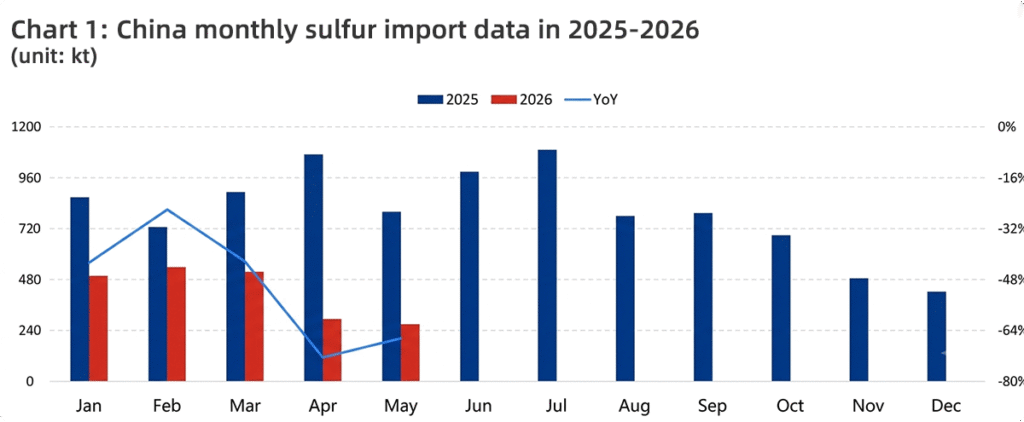
In May 2026, China imported 268,300 tons of sulfur, down 9.20% month-on-month and a sharp 66.41% year-on-year. Cumulative imports from January to May hit 2.1154 million tons, halving by 51.44% versus 2025. Monthly imports have posted steep YoY drops for four straight months. April 2026 already marked the second-lowest monthly import volume in 20 years; May set a new record low, only 31,800 tons above the all-time trough. Domestic sulfur supply remains chronically tight. The market traded sideways mainly because major phosphate fertilizer manufacturers received designated supply guarantees amid seasonal low demand, while traders held a wait-and-see attitude over potential shipping resumption at the Strait of Hormuz after the US-Iran memorandum.
Three Root Causes of Collapsed Imports
- Shipping bottlenecks at the Strait of Hormuz severely delay Middle Eastern sulfur deliveries.
- Global sulfur shortage pushes exporters to prioritize higher-bidding markets in Southeast Asia, South America and Africa, leaving China short of alternative supplies.
- Surging global spot prices curb import purchasing willingness of downstream factories and traders on risk aversion.
Shifts in Import Source Structure
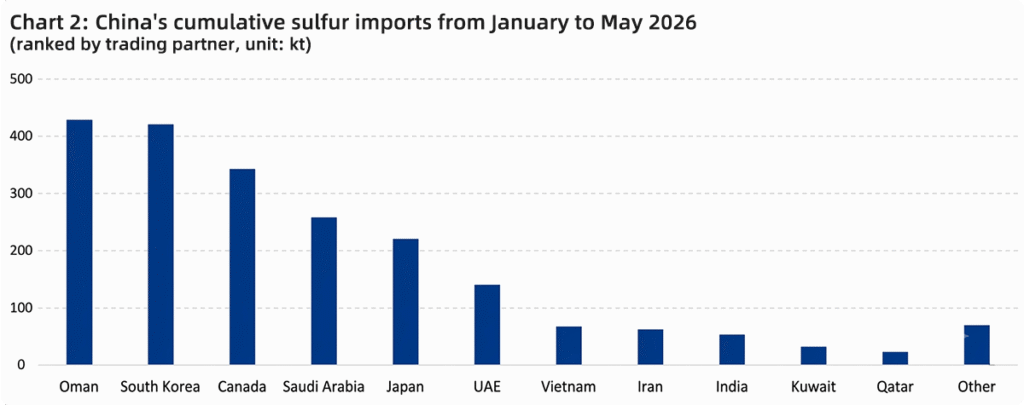
- Middle Eastern supply share shrinks drastically: Middle Eastern mainstream suppliers (Saudi Arabia, UAE, Kuwait, Qatar) accounted for over 30% of monthly imports for four months in 2025, yet only 4.60% in May 2026.
- Redrawn supplier ranking (Jan-May 2026 top 5): Oman, South Korea, Canada, Saudi Arabia, Japan. Traditional key suppliers UAE, Qatar and Kuwait slipped sharply, while South Korea, Japan and Canada regained prominence as passive substitutes rather than active choices.
Short & Medium-Term Import Outlook
- Short term (June-July): June imports may hit another annual low, possibly a 20-year bottom. Partial shipping recovery in July will not reverse low port inventories; YoY decline will still exceed 55% against 2025’s high base of 1.0936 million tons.
- Medium term (Q3): Imports may edge up slowly even if strait shipping normalizes. Chinese buyers will compete fiercely with global purchasers for limited cargoes. High prices will cap import enthusiasm, and Indonesia’s rising demand plus Russia’s extended sulfur export ban will keep global supply unfavorable for China’s import recovery.
Russia cuts sulfur export
Russia has extended the temporary export ban on industrial sulfur until December 31, 2026. The newly extended restriction will take effect on July 1, 2026 and remain valid until December 31, 2026. Controlled products include liquid sulfur, granular sulfur and lump sulfur.
Market impact: Russia normally exports 1.2 million to 1.5 million tons of sulfur annually. Continuous tightening of the export ban will bolster global spot sulfur prices. China relies on imports for nearly 50% of its sulfur supply. Russian sulfur accounts for 10% to 14% of China’s total sulfur imports, serving as a key land-sourced supply via Far East ports and railway transport. At present, this supply cut coincides with shipping disruptions in the Middle East, further widening the global supply gap.